Houston, TX |
A compressor reliability issue does not always begin with an obvious shutdown or catastrophic failure. In many cases, the earliest signs show up first in the data.
A gas compressor unit may still be running, but certain indicators can point to a developing issue long before the full impact is visible in the field. Below are some of the key reliability indicators discussed during the fourth episode of our Know Pressure: Your Guide to Compressor Fleet Management webinar series, and what they can reveal about a developing compressor issue before it escalates.
Key Takeaways:
- Developing reliability issues often show up in compressor data before they turn into failures.
- High rod load, excessive blowby, and changing pressure relationships can point to a deeper issue elsewhere in the compressor unit.
- Frequent, high-resolution data helps teams spot trends earlier and take action before compressor downtime escalates.
Track High Rod Load
High rod load is one of the most important reliability indicators for operators to watch because it reflects the mechanical force being placed on the rod and can be the first sign that something more serious is developing.
In the two case studies we covered in the webinar, rod load was the condition that first brought compressor units into focus. In one case, the issue had already escalated into a severe failure. In the other, it was caught early enough to investigate before the damage became more serious.
That contrast is part of what makes rod load so important to track. A unit may still be running, but rising rod load can be an early warning sign that the compressor is moving toward a larger reliability problem. It is not always the root cause, but it is often the signal that tells operators where to look next.
Track Excessive Blowby
Excessive blowby is another important indicator because it can reveal inefficiency that may not be obvious from raw operating data alone.
Blowby is a KPI that measures the difference between the expected and actual discharge temperatures. When actual discharge temperature runs higher than expected, it can point to recirculating gas, damaged valves, or other conditions that prevent a stage from moving gas as effectively as it should.
For both case studies, blowby helped explain why rod load remained elevated and why the issue was not isolated to a single stage. In simple terms, blowby pointed to performance loss inside the cylinder and helped show that inefficiency in one part of the compressor was creating stress somewhere else.
Track How Pressure and Work Shift Across the Unit
Pressure and loading do not always shift evenly across a compressor, which is why operators should also look beyond the first flagged condition. The case studies we discussed during the webinar showed that when one stage becomes less efficient, the effects can move upstream and create reliability problems somewhere else in the unit.
That is what made pressure relationships and compression ratio changes so important in these examples. Compression ratio, or how much the gas is being compressed across a stage, can help show when more work is being pushed onto one part of the unit. As inefficiency increased on later stages, suction pressure rose, more work shifted upstream, and rod load on stage one increased.
More broadly, when one part of the compressor begins to underperform, operators should look across the full unit to understand whether the real issue may be developing somewhere else.
Track Trends, Not Just Snapshots
Lastly, frequent, high-resolution data can make reliability indicators more useful because it helps operators see whether a condition is stable, worsening, or moving in step with another issue. As we noted during the webinar, the contrast between low-frequency manual entry and higher-frequency automated reporting helped show why that visibility matters.
When operators can only see isolated data points, it becomes much harder to tell whether a flagged condition is stable, getting worse, or connected to another issue. That is what makes higher-frequency data so valuable for prioritizing inspections and acting before a developing reliability issue turns into a failure.
If you missed the live session, you can watch on-demand here:
Jump to a Topic:
- What compressor reliability means and why it matters (2:50)
- The workflow for identifying compressor reliability issues (4:50)
- Case study #1: how rod load and blowby pointed to a deeper problem (6:00)
- How digital twin simulation helped narrow the likely cause (12:30)
- What field checks helped confirm the issue (15:50)
- Case study #2: how higher-frequency data helped catch a developing problem earlier (19:05)
- Key reliability takeaways for operators and maintenance teams (28:20)
Build a More Reliable Compressor Fleet
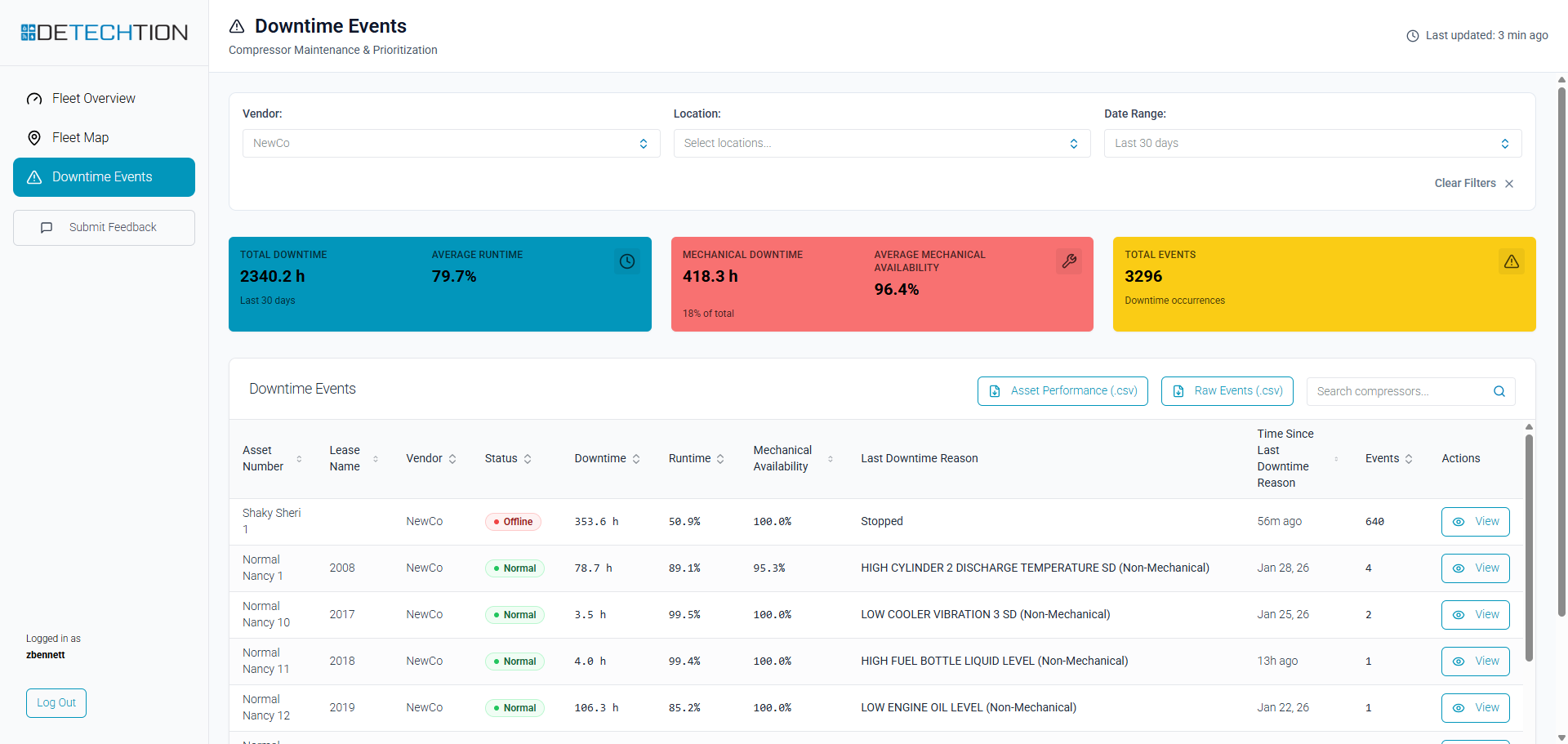
By automatically flagging these conditions across a fleet of gas compressors, teams can prioritize inspections, plan maintenance activities, and avoid unplanned failures.
Reliable compressor operations are built on data-driven decisions. Frequent, high-resolution data provides operators with the insights needed to catch issues before they escalate. As part of Detechtion’s Compression Optimization Suite, our digital twin simulation gives operators a predictive tool for anticipating performance and scheduling preventive maintenance.
At Detechtion, we help operators turn data into action across the compressor fleet. For a broader look at the other reliability indicators operators should track, read Chapter 4 of our Complete Guide to Compressor Fleet Management.